SNS Research Brief | 12/3/25
SNS Research Brief 114. Permanent Tolls on the Öresund Bridge – A Threat to Swedish Infrastructure Planning
Johan Nyström, Jonas Westin
Johan Nyström, Jonas Westin
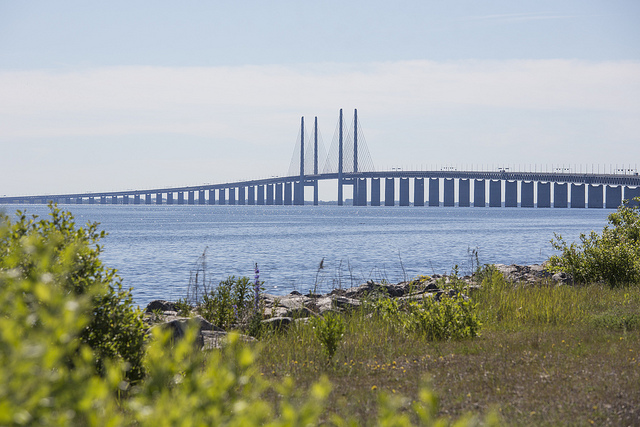
The Swedish government wants to keep the tolls on the Öresund Bridge even after it has been paid off. This represents a break with Swedish practice and risks undermining the socio-economic planning model regarding transport infrastructure.
This is shown in a new SNS report by Johan Nyström and Jonas Westin, who analyze the effects of a fiscal infrastructure fee.
In its latest infrastructure proposal (Prop. 2024/25:28), the Swedish government introduced a new financing model where the proceeds from the Öresund Bridge will be used to finance other infrastructures in the Öresund region – even after the bridge has been paid off.
This constitutes a break with the principle of marginal cost pricing used in Swedish transport planning, which states that road users should only pay for the societal marginal costs generated by their travel.
This report shows that the proposal challenges the current transport planning model and comes with risks concerning distorted investment decisions, poorer socio-economic efficiency, and reduced legitimacy with regard to transport planning.
“It is odd to introduce a new financing model that may have far-reaching effects on Swedish transport planning without having carried out an impact analysis,” according to Johan Nyström, one of the authors of the report.
Johan Nyström is a researcher in transport economics and affiliated with the Swedish National Road and Transport Research Institute (VTI) while also working at Nyfou.
Jonas Westin is an associate professor at the Department of Mathematics and Mathematical Statistics and a researcher at the Centre for Regional Science (CERUM), Umeå University.
This report is part of the SNS Infra research project, which highlights how Sweden may strengthen its essential infrastructure – physical as well as digital – for the future.
The project focuses on obstacles and opportunities concerning investments in transport, energy, water, and communication systems, with a particular focus on digitalization, financing, and collaboration between public and private actors.

Jonas Westin is an associate professor at the Department of Mathematics and Mathematical Statistics and a researcher at the Centre for Regional Science (CERUM), Umeå University.
Author
Jonas Westin


Stay updated with our latest insights, seminars and research news.