Research report | 10/8/26
Economic Impacts of CBAM for Sweden and Beyond
Christoph Böhringer, Knut Einar Rosendahl
Christoph Böhringer, Knut Einar Rosendahl
The EU is changing how emissions-intensive and trade-exposed industries are protected from the effects of climate policy. Free allocation of emissions allowances is being phased out for several important products and replaced by the EU Carbon Border Adjustment Mechanism (CBAM). But what does this shift mean for Swedish industry, the wider economy and the risk of carbon leakage?
In the SNS report Economic Impacts of CBAM for Sweden and Beyond, economists Christoph Böhringer and Knut Einar Rosendahl analyse the economic effects of different approaches to addressing competitiveness and carbon leakage when emissions are priced. Using data on global production, trade and emissions together with a simulation model of the world economy, they compare free allocation with carbon tariffs corresponding to CBAM.
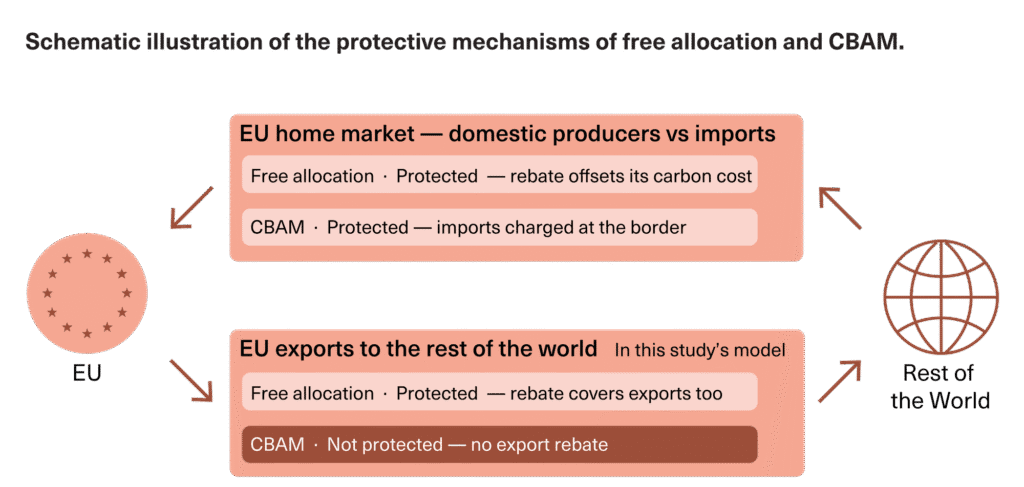
The analysis reveals a trade-off. Carbon tariffs provide less protection for Swedish emissions-intensive and trade-exposed industries than free allocation, partly because they do not protect exports to markets outside Europe. At the same time, the simulations show a lower economy-wide cost for Sweden, while the difference in carbon leakage is small.
In the simulations, output in Swedish emissions-intensive and trade-exposed industries is 1.3 per cent lower under carbon tariffs than in a hypothetical situation without climate policy. With free allocation, the corresponding reduction in output is 0.6 per cent. An important difference is that free allocation supports production regardless of whether goods are sold within or outside Europe, whereas carbon tariffs only protect producers against competition from imports in the European market.
For the Swedish economy as a whole, the results point in the opposite direction. With free allocation, the economy-wide welfare cost in the model is equivalent to around 0.05 per cent of real income compared with a hypothetical situation without climate policy. With carbon tariffs, the cost is even lower. One reason is that while free allocation protects output in the industries concerned, it also acts as a production subsidy, affecting how resources are allocated across the economy.
Both free allocation and carbon tariffs reduce carbon leakage compared with carbon pricing alone. The difference between the two instruments is small, however. In the simulations, the leakage rate is 16.9 per cent with free allocation and 16.0 per cent with carbon tariffs. When carbon tariffs are combined with export rebates, the leakage rate falls to 10.6 per cent.
The report also examines what happens if carbon tariffs cover more than the direct emissions from production. When emissions from the electricity used in production are also included, the outcome improves for Swedish emissions-intensive and trade-exposed industries, which benefit from a relatively low-carbon electricity supply. The report also analyses export rebates, which provide greater protection for European producers in markets outside Europe and further reduce carbon leakage.
The results show that the choice between free allocation and carbon tariffs involves different trade-offs. Free allocation provides greater protection for emissions-intensive and trade-exposed industries, while carbon tariffs result in a lower economy-wide cost for Sweden and the rest of Europe. The difference between the two instruments in terms of carbon leakage is small.
The scope of CBAM also matters. Including emissions from the electricity used in production improves the relative position of producers using low-carbon electricity, while export rebates strengthen protection in markets outside Europe. At the same time, the results show that neither instrument eliminates carbon leakage.
The report is part of SNS Climate, a three-year research project examining how climate policy affects the conditions for Swedish businesses and how the transition to a net-zero-emissions society can be carried out in a socioeconomically efficient manner.
Christoph Böhringer is Professor of Economics at Carl von Ossietzky University of Oldenburg, Germany.
Knut Einar Rosendahl is Professor of Economics at the Norwegian University of Life Sciences (NMBU).
Christoph Böhringer is Professor of Economics at Carl von Ossietzky University in Oldenburg, Germany.
Author
Christoph Böhringer

Knut Einar Rosendahl is Professor of Economics at the Norwegian University of Life Sciences (NMBU).
Author
Knut Einar Rosendahl




Stay updated with our latest insights, seminars and research news.